Showing posts with label halloween. Show all posts

Monday, October 31, 2016

Halloween Countdown Day 7: Happy Halloween! 🎃

Happy Halloween Chimp&Seers!!

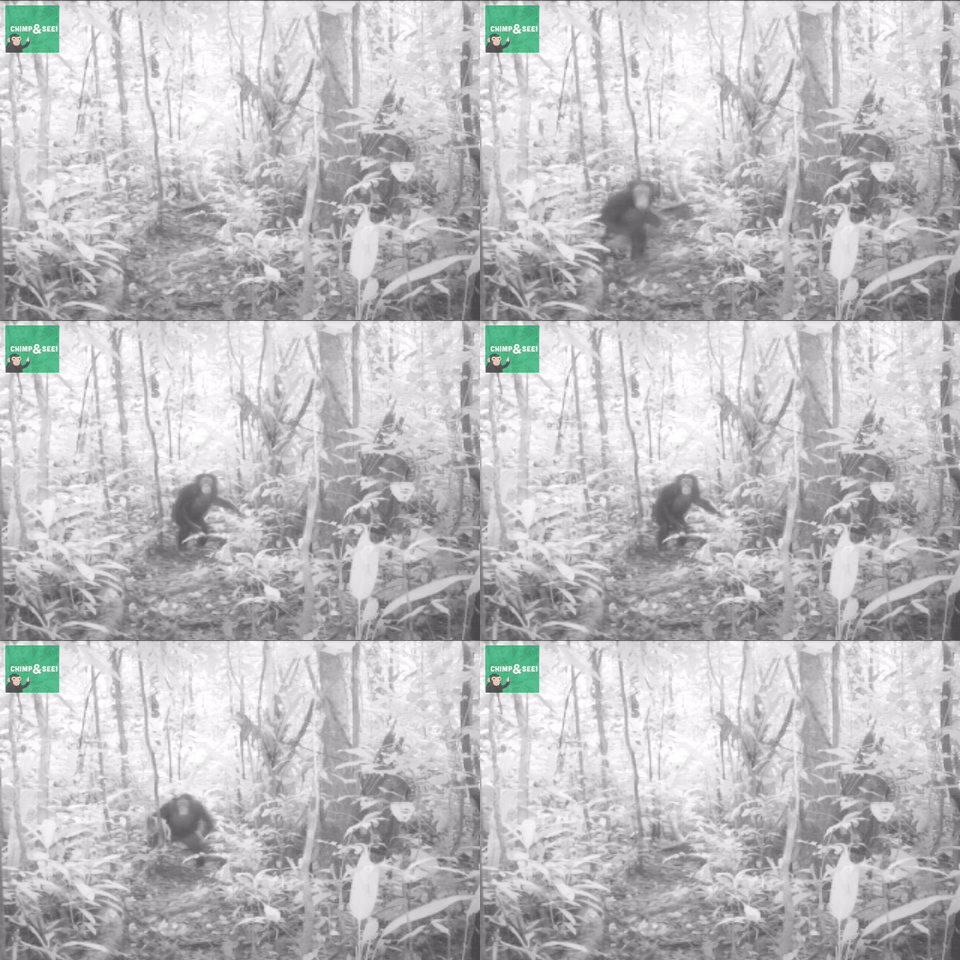
We hope you enjoyed this year's Halloween posts! Our final videos come full circle from where we started on Halloween Countdown Day 1! Based mostly on videos from the #camtouch tag group in the animal selfies project, we made a little clip collection we call "Chimp&See - Boo!". 

When you watch Chimp&See videos please help us with the video annotation by tagging appropriate videos with #camera_reaction #selfie and #camtouch as well as the species and site names (more details on how to participate HERE).


Have a very Happy Halloween everybody and when you're gorging on candy in the days to come, spend some of the sugary energy over at ChimpandSee.org! 

--
(original videos: ACP000emll, ACP000byws, ACP000bmg7, ACP000b6jg, ACP0007e75, ACP00083vi, ACP000c8hu, ACP000cc99, ACP000c8k2, ACP000bnby, ACP000emlm,ACP0002o89, ACP000c3dn, ACP000efpa, ACP000cdev, ACP000c8h8, ACP000esem, ACP000cdjy)

Saturday, October 29, 2016

Halloween Countdown Day 6: Creepy Crawlies

For Day 6 sit back, don't relax and check out the best videos from Chimp&See's #creepy collection from the last year!


Thanks to our citizen scientists @Boleyn for finding and tagging ACP000cbxi, ACP000b1t8, ACP000c7as and ACP00081h7 and to @Snorticus for ACP000e3rr and ACP0007yjr

Friday, October 28, 2016

Halloween Countdown Day 5: Pareidolia

Pareidolia is a psychological phenomenon involving a stimulus (an image or a sound) wherein the mind perceives a familiar pattern of something where none actually exists.This is often manifested as something like seeing jesus in a doggy butthole or a face on the surface of mars:

Shadow figures and ghosts have both been attributed to pareidolia and there are lots of websites dedicated to this phenomenon with many great examples (Photography and the paranormal (Paranormal Field Investigators), Pareidolia (Skepdic)).

Our moderator @AnLand found a great example of pareidolia earlier this year on Chimp&See:


So the big question is - why do we have this ability? 
Dr. Sinha of M.I.T. says that whether the hair-trigger response to faces is innate or learned, it represents a critical evolutionary adaptation...“The information faces convey is so rich   — not just regarding another person’s identity,   but also their mental state, health and other factors,” he said. “It’s extremely beneficial for the brain to become good at the task of face recognition and not to be very strict in its inclusion criteria. The cost of missing a face is higher than the cost of declaring a nonface to be a face.” (from Faces, Faces Everywhere" in The New York Times)
But it's not just us! At the most recent Chimpanzee Symposium: Chimps in Context, Dr. Masaki Tomonaga presented his latest findings that chimpanzees also share this ability:
Abstract -How chimpanzees perceive faces: an update after nine years of investigation  Faces play a special role in primate communication and social cognition, and as such they are processed in a different manner to other types of visual stimuli. We have been studying perception and cognition of faces in chimpanzees from the standpoint of comparative cognitive science. We initially reported some results at the last Chimpanzee Symposium (“The Mind of the Chimpanzee, 2007) and now, nine years later, I present the latest results from our continuing research project. First, as in humans, chimpanzees process facial stimuli in a holistic manner. When we see a non-facial object containing similar spatial configurations to faces (top-heavy patterns), we readily perceive it as a ‘face’. This phenomenon, often called ‘pareidolia’, was also observed in chimpanzees. In addition, when the spatial configuration of a face-like object was manipulated, the chimpanzee’s performances deteriorated, compared to when the same manipulation was applied to other types of stimuli. Secondly, chimpanzees tried to find facial configurations in noise patterns in which facial images did not exist. These results further support the notion that face processing in chimpanzees is holistic. Thirdly, faces include important social information such as gaze.  In a visual search task, in which chimpanzees were required to detect attentional state an attentive state, they showed quicker detection of an inattentive state than humans.
Perhaps the most halloweeny, primate-related example of pareidolia is the monkey orchid whose scientific name is Dracula simia! You can see more pareidolic orchids here :)


Halloween Countdown Day 4: Mystery Monster

My tongue is as long as my body 
and I have a toothless grin
I'm totally covered in armour
so lions can't bite through my "skin"

I walk on 2 legs like a T-rex
and my front feet are powerfully clawed
When threatened I fart out some stink juice
and roll myself into a ball

My diet's entirely insects
and my saliva is extra sticky
my stomach is lined with spines
I eat rocks so digestion's less tricky

I'm the world's most hunted animal
and that's the real Halloween scare
Can you guess who I am from these clues?
Go ahead, scroll below, if you dare!

original video: https://talk.chimpandsee.org/#/subjects/ACP0004km5


I'm a pangolin!


original video: https://talk.chimpandsee.org/#/subjects/ACP0004f41

We have incredible giant pangolin and tree pangolin video collections and Chimp&See! And we are very fortunate to be collaborating with the IUCN Pangolin Specialist Group to help determine the range and conservation status of these fascinating species. For more information on how amazing and unique pangolins are and how you can help them, check out:

Thursday, October 27, 2016

Halloween Countdown Day 3: Eerie Elephants

Elephant videos on chimp&see are always spectacular and a bit mysterious - how is it that these forest giants can quietly appear out of nowhere and navigate the forests so elegantly?


Elephants (and their cousins) have captured the imagination of people for as long as humans have recorded history
from http://de.phaidon.com/agenda/art/picture-galleries/2011/march/10/inside-the-cave-of-forgotten-dreams/
One especially bittersweet legend comes from Kenya:
"A myth of the Kamba in Kenya tells us how elephants originated. A very poor man heard of lvonya-Ngia, 'He that feeds the Poor'. He decided to go and find Ivonya-Ngia but it was a long journey. When he finally arrived, he saw uncounted cattle and sheep, and there, amidst green pastures, was the mansion of Ivonya-Ngia, who received the poor man kindly, perceived his need and ordered his men to give him a hundred sheep and a hundred cows. 'No', said the poor man, 'I want no charity, I want the secret of how to become rich.' Ivonya-Ngia reflected for a while, then took a flask of ointment and gave it to the poor man, saying: 'Rub this on your wife's pointed teeth in her upper jaw, wait until they have grown, then sell them.' The poor man carried out the strange instructions, promising his wife that they would become very rich. After some weeks, the canine teeth began to grow and when they had grown into tusks as long as his arm the man persuaded his wife to let him pull them out. He took them to the market and sold them for a flock of goats. After a few weeks the wife's canine teeth had grown again, becoming even longer than the previous pair, but she would not let her husband touch them. Not only her teeth, but her whole body became bigger and heavier, her skin thick and grey. At last she burst out of the door and walked into the forest, where she lived from then on. She gave birth to her son there, who was also an elephant. From time to time her husband visited her in the forest, but she would not be persuaded to come back, although she did have more healthy children, all elephants." (via a-gallery.de)
I find this especially lovely as it constructs a clever origin story for why elephants are so much like us; both intelligent and kind of stubborn. It also subtly builds an argument to respect them and that they represent something we have lost and should revere. Finally I think there is a clever nod to the female social structure of elephants here: generations of grandmothers, mothers and their subadult children travelling together, with adult males occasionally meeting the female groups.

We have many amazing elephant videos at Chimp&See - check out the collection HERE

Wednesday, October 26, 2016

Halloween Countdown Day 2: Sneaky Snakes 🐍

Citizen scientist @Snorticus found this amazingly clear and huge black cobra at our Aged Violet site this year. You can see the snake in these videos ACP000eg9h ACP000eg9i ACP000eg9k ACP000eg9m and it moves ever sssssso ssssssslightly in the second one (and below)!


Although snakes are often considered scary, sometimes that fear can help with their survival! A study from Nigeria found in 2013 that taboos for certain snakes resulted in their protection:
(Table adapted from Dagba et al. 2013)
"In almost every traditional African setting or community, each community has what they revere or hold sacred either as the presence of their gods or their goddesses, or there is a very important role such objects played in the course of their existence and history. The belief in chimpanzee as “totem”, that is animal into which human beings could transform is also common in many localities in the forest zones of Nigeria... In Nnewi, Awka and Mbaise communities in South east zone of Nigeria, python is man’s friend, the killing of python is an abominable act, so it is held sacrosanct. Among the Ngas of Plateau State, Nigeria, it is believed that the spirit of the gods lives in Python and that it gives protection to the people. The Tiv people regard the green snake as a totem. They believe that the snake assisted them in crossing the River Congo in Central Africa, so they see it as a friend and do not kill it." (Dagba et al., 2013)
 And another study from Cameroon published in 2015 found that:
"Segment taboos are manifested by the restriction of women and children from consuming certain animals such as Red river hog (according to 15.6% of [household residents] HRs), Snakes (according to 8.5% of  HRs) and most primates. It is however important to note that threats to wildlife is real. An evaluation of the perceptions of HRs on the use level of wildlife showed that, wildlife use for cultural and traditional purposes is disappearing progressively (according to 96.7% of HRs). This trend was mainly because of the scarcity of wildlife (65.3% of HRs) and the loss of culture among the youths (12.5% of HRs)." (Bobo et al. 2015)
The take home message is that when we understand the importance of a species, we are much better at protecting it. So even if your culture doesn't revere or fear snakes, we can all learn to value them and the important ecological functions they play! 
🐍🐍🐍🐍🐍🐍🐍🐍🐍🐍🐍🐍🐍🐍🐍🐍🐍🐍🐍🐍🐍🐍🐍🐍🐍🐍🐍

References:
Dagba BI, Sambe LN, and Shomkegh SA  (2013) Totemic Beliefs and Biodiversity Conservation among the Tiv People of Benue State, Nigeria. Journal of Natural Sciences Research 3(8): 145

Bobo KS, Aghomo FFM and Ntumwel BC (2015) Wildlife use and the role of taboos in the conservation of wildlife around the Nkwende Hills Forest Reserve; South-west Cameroon. 
Journal of Ethnobiology and Ethnomedicine 11(2): doi: 10.1186/1746-4269-11-2

Tuesday, October 25, 2016

Halloween Countdown Day 1: Update on our spooktacular camera reactions project!

Hi everyone! To kick off this year’s Chimp&See Halloween countdown, , we’ve put together some highlights of the near 'frightened' #camera_reactions we've observed so far thanks to your participation in the animal selfies project!

Usually the animals are more cautious or curious about the camera traps (when they notice them at all) but we have seen some startled chimpanzees (ACP00083cu, ACP00083vi), baby elephants (ACP00022hm, ACP000bgq8), and even a beautiful sooty mangabey seeming a bit surprised by the camera (ACP000fca6)! Here’s also a very spooky night video of a cautious bushpig wary of the camera, and listen carefully for the alarm grunt (ACP000bjlc).


Of course we never intend to scare wild animals when using camera-traps, and in fact we take extra care to camouflage the devices and use settings that will not startle the animals which is why 'surprised' and 'frightened' responses should be rare. For some of these exact reasons, the PANAF uses Bushnell Trophy Cameras with an infrared sensor that produces minimal light when triggered by an animal's movement. The Bushnell Trophy Cameras are also quiet, small, lightweight, and therefore easy to install in wild landscapes from the forest to the savannas.  

The camera traps are also given some extra protection and camouflage, particularly from those elephants who can do some serious damage! The camera-traps are placed inside a small tupperware container, sealed tight, and painted dark green (and sometimes they even get an extra metal box of protection too) This further prevents reflections from the camera lens occurring which reduces the likelihood that the camera surprises an animal. Of course we know that animals, especially primates, are exceptionally curious and therefore all the above precautions do not prevent regular #camtouch, #selfies, and #camera_reactions, from occurring. Please keep tagging videos where you observe chimpanzees, gorillas, baboons, and elephants detecting (I.e #camera_reaction), playing or inspecting (e.g. #camtouch) the camera-traps as this will help us to gain a better understanding of what factors in the habitat and species-specific behaviour increases camera-trap interaction by individuals. Of course hashtagging other species' camera reactions is also welcome but we are concentrating on these animals first.

Thanks to the efforts of our citizen scientists and dedicated chimpandsee moderators, we now have a staggering 500+ clips of #baboon #camera_reactions and we are just shy of 500 #chimp #camera_reactions. Gorillas are also observed to react to cameras with 40 videos so far of #gorilla #camera_reaction and 125 #elephant #camera_reactions. With your continued help we look forward to discovering many more interesting, funny, and surprising reactions to the camera traps, especially as new videos are uploaded to the site. Happy Halloween :)

-the science team

Thursday, October 22, 2015

Halloween countdown from Chimp&See!

For the next 10 days we'll been showcasing some of Chimp&See's spookiest videos on facebook and twitter filled with things that go bump in the night (and sometimes during the day too)! Check back here daily to see what makes our top 10 list!

10) Chimp&See's Spooky Rompo 

We started the countdown with this video from Crimson Dew that sets the tone perfectly and was found by modertaor jwidness. Its just an illusion created by a foggy and wet camera lens (or is it?!? muahhahahahahahah!) or perhaps the legendary Rompo?


original video can be found here: http://talk.chimpandsee.org/#/subjects/ACP00052tm1


9) Spiders
We've got some great spider videos on Chimp&See, sometimes they can even be a bit distracting! Citzien scientist Boleyn commented that "because of the #spider I almost missed the #genet" on this video from Muddy frost: http://talk.chimpandsee.org/#/subjects/ACP0003qe1 


Also, we suspect that these floaty orbs found by StarwatcherHB and Zanna640 are actually out of focus spiders near the camera lens at Dry Lake but secretly we hope they are benevolent forest spirits like the Kodama or Yumboes. http://talk.chimpandsee.org/#/subjects/ACP0006w71 

Here are a few more spider videos to make your skin crawl:

8) Elephantom
Citizen scientist moderator ksigler noted that these elephants seems to appear out of nowhere at Cool Silence. It's amazing how in all of our videos these massive beasts seem to be so unobtrusive in the forest, ghost-like one might say.
http://talk.chimpandsee.org/#/subjects/ACP0002p15 


7) Attack of the not so killer bees
Citizen scientist Eswiniarski is pretty sure that this guinea baboon was stung by a bee in this video from Dry Lake. Luckily he seems to have made a quick recovery.


originals here: http://talk.chimpandsee.org/#/subjects/ACP000726c and http://talk.chimpandsee.org/#/subjects/ACP000726d 


6) Ghost & Pirate Chimps 
Night mode on our camera traps sometimes makes the chimps look extra ghostly on the videos. Citizen scientist MargC found that our ginger chimp from Dry Lake named Roux looks especially pale in black and white (http://talk.chimpandsee.org/#/subjects/ACP0006ovo and you can see more videos of Roux here: http://talk.chimpandsee.org/#/collections/CCPL0000fm)


While matching chimps, we rely on special features that distinguish each chimp from one another.The night videos are often tricky for this purpose since many of the features get washed out in low light. Citizen scientists Eswiniarski and AnLand noticed however that this male chimp from Lingering Shape has a special feature that is probably only seen at night: a right eye that does not reflect any light. 
(original videos: http://talk.chimpandsee.org/#/subjects/ACP0005mzg and http://talk.chimpandsee.org/#/subjects/ACP0005mz8)


5) Fires of Samhain
Before Halloween was Halloween, it was Samhain. And a big part of Samhain is fire. "It is suggested that the fires were a kind of imitative or sympathetic magic – they mimicked the Sun, helping the "powers of growth" and holding back the decay and darkness of winter. They may also have served to symbolically "burn up and destroy all harmful influences".Accounts from the 18th and 19th centuries suggest that the fires (as well as their smoke and ashes) were deemed to have protective and cleansing powers".

We have a lot of fires at our current site Dry Lake and they burn during the day and night. Some are natural due to the dryness of the site and some are set by people for agricultural purposes.


How do chimpanzees react to fire you ask? Check out this paper by Pruetz and LaDuke "Reaction to fire by savanna chimpanzees (Pan troglodytes verus) at Fongoli, Senegal: Conceptualization of "fire behavior" and the case for a chimpanzee model."


Thanks to citizen scientists starwatcherHB, Morra and clt21duke for highlighting these great clips (http://talk.chimpandsee.org/#/subjects/ACP0006r5w , http://talk.chimpandsee.org/#/subjects/ACP00075a6 , http://talk.chimpandsee.org/#/subjects/ACP0006ob4)


4) The forests have eyes (and they are adorable, I mean spooky)


Thanks to citizen scientists jwidness and snorticus for finding these great clips from Red Water and Dry Lake! (http://talk.chimpandsee.org/#/subjects/ACP0003a1x , http://talk.chimpandsee.org/#/subjects/ACP0007ape)


3) Halloween photobomb
Ever get that feeling that there is sssssssssssome body behind you? Citizen Scientist rlb66xyz 6 noticed that this Cool Silence duiker is being seriously photobombed by a snake slithering towards it in the lower right part of the video right above the duiker's head. Sssssssssssssneaky!


(original video: http://talk.chimpandsee.org/#/subjects/ACP0002nqg) 


2) Going batty
You wouldn't guess that we'd get a lot of bats on our camera traps - but we do! In this clip from Quiet Wood citizen scientist markehurd saw something a bit batty in this red river hog video clip


(original video here: http://talk.chimpandsee.org/#/subjects/ACP00004ei)

And If you want to check out more bat videos visit our bat tag group: http://talk.chimpandsee.org/#/collections/CCPL00000l


1) A potto, a galago and the legend of the egbere
We did not expect to see the more elusive smaller primates like galagos (bushbabies) and pottos in our video footage. But our amazing, observant and patient citizen scientists managed to find both! We end our Halloween countdown with this legend from Nigeria about bushbabies.
Bushbabies in the Yoruba language are called 'egbere' and their legend has been passed from generation to generation. The egbere are little, supernatural human like creatures(or spirits) that wonder through the forest carrying a mat (their tail) and lamp (their eyes). Their unique cry sounds like that of a child or little baby which lures humans to them at night.According to popular folklore, bushbabies are usually encountered by hunters deep in the forests. It is said that anyone who is able to steal an egbere's mat will become rich. But, the person has to withstand 7 days of tribulation caused by the creature who wants its property back and the hunter must not lose site of the mat during this time. During those days, the person will not be able to sleep because of the creature's incessant cries which only he can hear. If the person gives up within the 7 days, the Bush Baby will kill them, the fate that awaits most people who try to steal the egbere's mat!
adapted from http://www.mojidelano.com/2013/11/when-folklore-meets-reality-bush-baby.html and http://knowalotmore.blogspot.de/2012/12/top-5-scariest-nigerian-spirit-creatures.html


Click here to see all our galago videos: http://talk.chimpandsee.org/#/collections/CCPL00009e
and potto videos: http://talk.chimpandsee.org/#/collections/CCPL0000h3

We hope you enjoyed our 10 day countdown and we wish you a very Happy Halloween from Chimp&See!